
7 Best Career Opportunities After a Digital Marketing Course
The Career Opportunities After a Digital Marketing Course have expanded as businesses increasingly depend on websites, search engines, social media, online advertising, and digital content to communicate with customers. Students, graduates, entrepreneurs, and working professionals in Kerala can explore different roles based on their interests, practical abilities, and long-term career goals.
Completing a course is only the beginning of the journey. A learner must understand how various marketing channels work, practise with professional tools, build a portfolio, and develop the confidence to handle real projects.
The most suitable Career Opportunities After a Digital Marketing Course depend on whether you enjoy writing, analysing data, designing campaigns, communicating with audiences, managing websites, or planning business strategies.
This guide explains major career options, the reasons behind growing demand, different employment paths, skills employers look for, common difficulties, and practical ways to start a digital marketing career.
What Are the Career Opportunities After a Digital Marketing Course?
The Career Opportunities After a Digital Marketing Course include specialised and general marketing roles that help businesses improve online visibility, attract audiences, generate enquiries, and measure campaign performance.
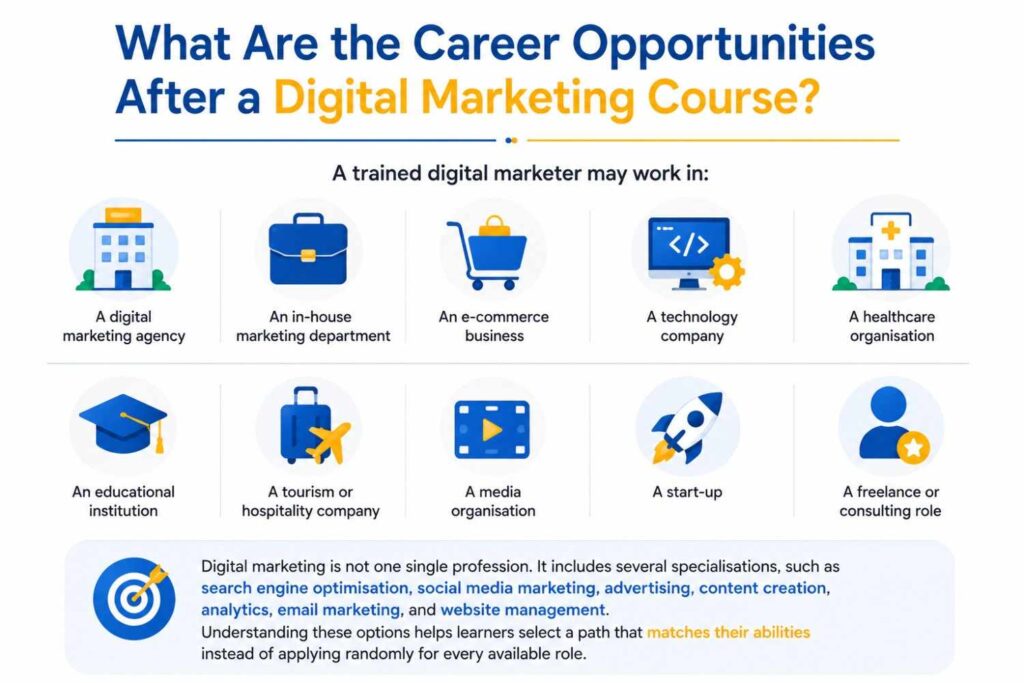
A trained digital marketer may work in:
- A digital marketing agency
- An in-house marketing department
- An e-commerce business
- A technology company
- A healthcare organisation
- An educational institution
- A tourism or hospitality company
- A media organisation
- A start-up
- A freelance or consulting role
Digital marketing is not one single profession. It includes several specialisations, such as search engine optimisation, social media marketing, advertising, content creation, analytics, email marketing, and website management.
Understanding these options helps learners select a path that matches their abilities instead of applying randomly for every available role.
Why Digital Marketing Career Demand Is Growing
The demand for trained professionals is one of the main reasons learners research Career Opportunities After a Digital Marketing Course.
Customers now use online platforms to compare services, research products, read reviews, watch videos, and contact businesses. Organisations therefore require professionals who can manage their digital presence and convert online attention into meaningful business results.
Growth of Online Business Activity
Businesses of different sizes now maintain websites, social media accounts, online catalogues, and digital advertising campaigns.
Even organisations that mainly operate offline use digital platforms to share information and attract local customers.
Need for Measurable Marketing
Traditional marketing can sometimes be difficult to measure accurately. Digital platforms provide information about impressions, clicks, enquiries, purchases, calls, and customer actions.
Professionals who can interpret this information are valuable to employers.
Expansion of E-commerce
Online stores require marketers to manage product visibility, paid advertising, email campaigns, customer retention, and conversion optimisation.
This growth has created additional Career Opportunities After a Digital Marketing Course for people interested in online retail.
Increased Use of Social Media
Businesses use social media for brand communication, customer support, lead generation, product education, and community building.
This has increased demand for social media executives, content creators, campaign managers, and paid-media specialists.
Development of AI Tools
Artificial intelligence has changed how marketers research, write, analyse, automate, and plan campaigns.
However, businesses still need professionals who can verify information, understand audiences, make strategic decisions, and use AI responsibly.
Types of Career Opportunities After a Digital Marketing Course
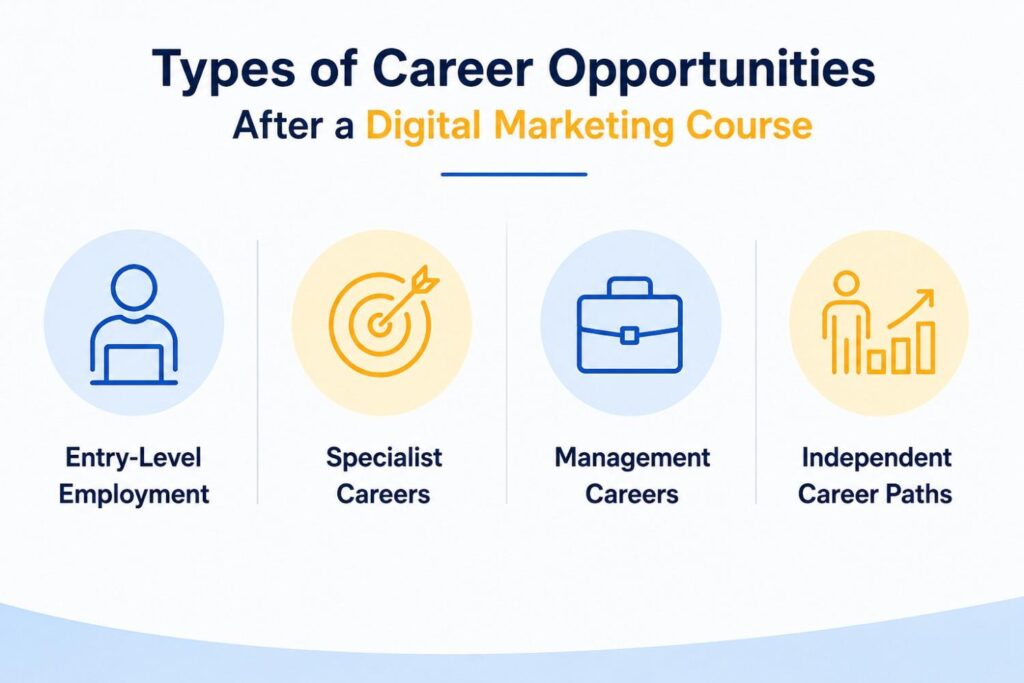
The Career Opportunities After a Digital Marketing Course can be organised into four broad types.
Entry-Level Employment
Entry-level roles are suitable for fresh graduates and beginners who need professional exposure.
Common positions include:
- Digital Marketing Trainee
- SEO Trainee
- Social Media Executive
- Content Marketing Assistant
- PPC Trainee
- Marketing Intern
- Junior Digital Marketing Executive
These roles usually involve working under experienced professionals while learning tools, reporting methods, and project workflows.
Specialist Careers
Specialists concentrate on one major area of digital marketing.
Examples include:
- SEO Specialist
- Google Ads Specialist
- Social Media Manager
- Content Strategist
- Email Marketing Specialist
- Marketing Automation Executive
- Web Analytics Specialist
Specialisation can help professionals build deeper expertise and handle more complex responsibilities.
Management Careers
Experienced professionals may progress into positions that involve strategy, budgeting, team coordination, and client management.
Examples include:
- Digital Marketing Manager
- Performance Marketing Manager
- SEO Manager
- Content Marketing Manager
- Social Media Lead
- Digital Strategy Manager
- Head of Digital Marketing
Independent Career Paths
Not every learner chooses traditional employment. Other Career Opportunities After a Digital Marketing Course include:
- Freelancing
- Digital marketing consulting
- Affiliate marketing
- Blogging
- Content creation
- Personal branding
- Online business management
- Agency entrepreneurship
Independent work requires marketing knowledge as well as communication, pricing, time management, and client-handling abilities.
7 Major Career Opportunities After a Digital Marketing Course
1. Search Engine Optimisation Executive
SEO is one of the most popular Career Opportunities After a Digital Marketing Course.
An SEO executive helps improve a website’s visibility in search engine results. The role combines research, content optimisation, website analysis, and performance monitoring.
Typical responsibilities include:
- Conducting keyword research
- Studying search intent
- Optimising website pages
- Writing title tags and meta descriptions
- Improving internal linking
- Checking technical SEO issues
- Monitoring search performance
- Analysing competitor websites
- Supporting link-building activities
- Preparing ranking and traffic reports
SEO may suit people who enjoy research, problem-solving, writing, and data analysis.
Career growth may progress from SEO trainee to SEO executive, SEO analyst, SEO specialist, SEO manager, and SEO consultant.
A strong SEO portfolio can include keyword research sheets, content briefs, technical audits, ranking improvements, and Google Search Console reports.
2. Social Media Marketing Executive
Social media management is another widely chosen option among the Career Opportunities After a Digital Marketing Course.
A social media executive plans and publishes content while helping a business communicate consistently across relevant platforms.
Responsibilities may include:
- Researching the target audience
- Developing content ideas
- Creating monthly calendars
- Writing captions
- Coordinating designs
- Scheduling posts
- Responding to comments
- Monitoring brand mentions
- Reviewing engagement
- Preparing reports
Social media professionals must understand that each platform has different audiences and content formats.
For example, a professional service may use LinkedIn for industry communication while a lifestyle brand may focus more heavily on Instagram or YouTube.
This role may suit creative learners who enjoy communication, visual content, storytelling, and audience engagement.
Career progression can include social media executive, senior executive, social media strategist, social media manager, and brand communication lead.
3. Performance Marketing Executive
Performance marketing is one of the data-focused Career Opportunities After a Digital Marketing Course.
A performance marketer manages paid campaigns on search engines, social media platforms, video networks, and other advertising channels.
Common duties include:
- Selecting campaign objectives
- Conducting keyword research
- Creating audience segments
- Writing advertisement copy
- Coordinating creative materials
- Setting campaign budgets
- Installing conversion tracking
- Reviewing cost per click
- Measuring cost per lead
- Testing different advertisements
- Improving campaign results
This role requires careful budget management. A campaign should not be judged only by the number of clicks it receives.
The marketer must determine whether those clicks produce valuable actions such as enquiries, purchases, registrations, bookings, or qualified leads.
Performance marketing may suit people who enjoy numbers, experimentation, business strategy, and continuous optimisation.
Career growth can lead to positions such as PPC specialist, paid-media specialist, performance marketing manager, acquisition manager, and growth marketing manager.
4. Content Marketing Executive
Content marketing provides suitable Career Opportunities After a Digital Marketing Course for people who enjoy writing, research, editing, and storytelling.
A content marketer creates useful information that helps a business attract, educate, and engage its audience.
Content formats may include:
- Blog articles
- Website pages
- Landing pages
- Email newsletters
- Social media posts
- E-books
- Case studies
- Video scripts
- Product descriptions
- Infographics
A content marketing executive must understand both the reader and the business objective.
For example, an educational article may explain a topic, answer common questions, and guide the reader towards a relevant service page.
Good content marketing involves more than placing keywords into an article. It requires accuracy, structure, clarity, originality, and a clear understanding of search intent.
Career progression may include content writer, SEO content writer, content marketing executive, content strategist, content editor, and content marketing manager.
5. Email Marketing and Automation Specialist
Email marketing is one of the relationship-focused Career Opportunities After a Digital Marketing Course.
An email marketing specialist plans communications that guide subscribers, leads, and customers through different stages of their journey.
Common responsibilities include:
- Building permission-based email lists
- Segmenting audiences
- Writing subject lines
- Creating newsletters
- Developing automated sequences
- Personalising messages
- Conducting A/B tests
- Monitoring open rates
- Measuring clicks
- Tracking conversions
Automation can help businesses send relevant messages based on user activity.
For example, a person who downloads an informational guide may receive educational emails, while an existing customer may receive product updates or service reminders.
This career may suit people who enjoy writing, customer psychology, automation, data, and campaign planning.
Possible career paths include email marketing executive, CRM executive, automation specialist, lifecycle marketer, and customer retention manager.
6. Web Analytics Executive
Web analytics is one of the most analytical Career Opportunities After a Digital Marketing Course.
An analytics executive studies how users find and interact with websites and digital campaigns.
The role may involve:
- Reviewing website traffic
- Analysing traffic sources
- Setting up events and goals
- Checking conversion journeys
- Studying user behaviour
- Building performance dashboards
- Comparing campaign results
- Identifying website problems
- Presenting insights
- Recommending improvements
An analytics professional must convert numbers into understandable findings.
A report should not merely state that traffic increased. It should explain where the visitors came from, what they did, whether they converted, and what action should be taken next.
This role may suit learners who enjoy spreadsheets, numbers, patterns, reporting, and logical problem-solving.
Career progression may include analytics executive, web analyst, marketing analyst, conversion analyst, business intelligence specialist, and analytics manager.
7. Digital Marketing Executive
A general digital marketing executive role is among the most flexible Career Opportunities After a Digital Marketing Course.
Instead of focusing on one channel, a digital marketing executive may support several activities, including:
- SEO
- Social media
- Content publishing
- Email campaigns
- Website updates
- Paid advertising
- Analytics
- Reporting
This position is common in smaller companies where one professional may coordinate multiple digital tasks.
It can be a useful entry point because it provides exposure to different channels. After gaining experience, the professional can choose a specialisation based on interest and performance.
Career progression may lead to senior digital marketing executive, digital marketing specialist, digital marketing manager, marketing strategist, and head of marketing.
Benefits of Choosing a Digital Marketing Career
The Career Opportunities After a Digital Marketing Course offer several advantages.
Multiple Specialisations
You can choose a field based on your strengths, such as writing, research, advertising, design coordination, analytics, or strategy.
Opportunities Across Industries
Digital marketing professionals work in education, healthcare, tourism, finance, retail, real estate, technology, manufacturing, and many other industries.
Portfolio-Based Growth
Professionals can demonstrate their abilities using real projects, reports, content samples, websites, and campaign results.
Freelance Flexibility
Experienced professionals may work with multiple clients or offer specialised services independently.
Continuous Learning
The industry provides frequent opportunities to learn new platforms, tools, technologies, and strategies.
Career Progression
Entry-level professionals can move into specialist, managerial, consulting, and leadership positions as they gain experience.
Practical Treatments for Career Skill Gaps
Career difficulties are not medical conditions, but they can be managed through a structured improvement process.
Build a Focused Portfolio
Choose projects that match your preferred role.
An SEO applicant may include:
- Keyword research
- Website audits
- Content optimisation
- Search performance reports
A social media applicant may include:
- Content calendars
- Caption samples
- Campaign concepts
- Engagement reports
Gain Internship Experience
Internships introduce learners to deadlines, teamwork, client communication, reporting, and real campaign challenges.
Work on Personal Projects
Create a blog, optimise a small website, build a social media page, or prepare a sample advertising plan.
Personal projects show initiative and create opportunities to practise without waiting for employment.
Earn Relevant Certifications
Platform certifications can support your resume, but they should be combined with practical application.
Improve Communication
Practise explaining your projects clearly. Employers may ask what you did, why you selected a strategy, and what you learned from the result.
Customise Every Application
Read the job description and highlight skills that are directly relevant to the position.
Avoid sending the same generic resume to every employer.
Conclusion
The Career Opportunities After a Digital Marketing Course include creative, analytical, technical, and management-oriented roles. Learners can begin as trainees or junior executives and gradually progress into specialist, managerial, freelance, consulting, or entrepreneurial positions.
Completing practical projects, building a focused portfolio, gaining internship experience, and developing communication skills can improve career readiness. For learners in Kerala, selecting the right opportunity should be based on personal strengths, genuine interests, practical exposure, and willingness to keep learning.
For additional information about digital marketing fundamentals, best practices, and career opportunities, visit the Grow with Google – Digital Marketing Guide.